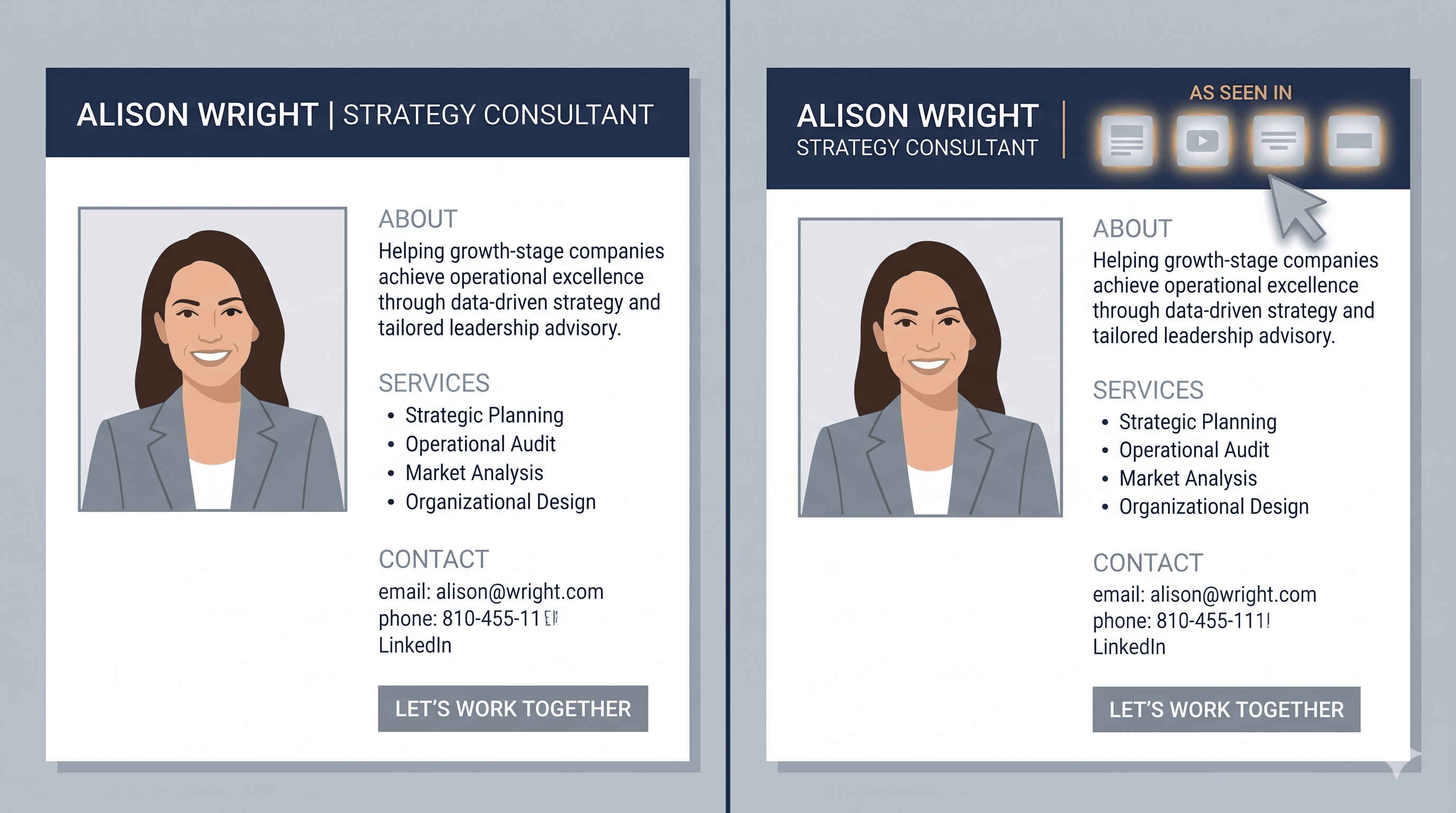
You're losing business to consultants who are not better than you. They're just easier to trust on sight.
The prospect Googles your name. They visit your site. Nothing tells them you're the real thing no third-party proof, no media mentions, no signal that anyone outside your existing client base has verified your expertise. So they book a call with someone else. The project you should have won goes to a competitor whose website quietly says Forbes, Entrepreneur, Business Insider at the top of the page.
This isn't a reputation problem. It's a credibility infrastructure problem. And you don't need a six-month PR retainer, a publicist, or a $10,000 media budget to fix it. You need a few targeted moves that build verifiable authority fast — the kind that works while you sleep, before the sales call even starts.
These five approaches work specifically for consultants, coaches, and independent advisors who operate without a marketing team and can't afford to play the long game with a traditional PR agency.
Consultants lose clients not because of weak expertise but because their credibility is invisible online. Five moves change this without a PR retainer: get one press release distributed to high-authority outlets, add a dynamic "As Seen On" badge to your website, place your media links in your email signature and LinkedIn, create one original data point your market doesn't have, and request one strategic podcast appearance. Each move creates a verifiable trust asset that works before, during, and after every sales conversation.
The consulting market is structurally credibility-hostile. You're asking clients to hand over significant money — and sometimes operational control — to a single person with no storefront, no physical product, and no institutional backing. Your degrees, your testimonials, and your LinkedIn profile are self-reported. Prospects know this.
What changes the equation is third-party verification: evidence that an entity outside your own orbit has evaluated you and found you credible. This is what earned media does that no amount of LinkedIn posting replicates. A well-placed press feature says, in effect, an editorial team reviewed this person and decided they were worth publishing. That's a trust transfer no sponsored post can manufacture.
The problem is that the traditional path to earned media — hiring a PR agency on a retainer — is designed for companies with marketing departments, not for solo consultants or small advisory practices. Retainers typically start at $3,000–$5,000 per month, run for six to twelve months before generating meaningful results, and require a level of ongoing management that most independent consultants simply don't have bandwidth for.
Research from Q1 2026 across dozens of buyer testimonials found that the most common complaint at this price tier is paying for "strategy hours" with nothing verifiable to show for it.
The alternative is not doing nothing. It's building credibility infrastructure through targeted, one-time moves that create permanent assets — not ongoing obligations.
A single professionally written and distributed press release, placed across legitimate high-authority news outlets, gives you something most consultants never have: verifiable proof of existence that lives on the open web and in search results.
This matters for three reasons that go beyond vanity. First, when a prospect Googles your name, a press feature on a recognizable news domain appears in results and immediately signals legitimacy. Second, press placements create do-follow backlinks from high-domain-authority sites, which compounds your SEO position over time. Third — and most practically — you now have real URLs to show, share, and embed.
The key word is real. The press release distribution market is littered with services that promise placement on major outlets while delivering content on spoofed domains (Forbes.zone is not Forbes) or buried wire feeds that generate zero traffic and zero trust. What you want is confirmed placement on sites with genuine domain authority, editorial standards, and real audiences. Verify placement URLs before you pay anything.
A one-time package from a legitimate distribution service — written professionally and distributed to a relevant outlet network — typically runs between $500 and $1,500. That's a single spend with permanent results, not a monthly obligation. For a consultant billing $5,000 to $20,000 per project, one client won partly on the strength of visible credibility more than covers the cost.
The deployment move: Once your press release is live, save every placement URL. You'll need them for Hack 2.
→ See how Brand Featured's packages handle this: brandfeatured.com/news-media-placements
This is the single highest-leverage change most consultants can make to their website in under an hour — and almost none of them do it.
An "As Seen On" or "As Featured In" section near the top of your homepage or services page takes the press coverage you've earned and converts it into a visual trust signal that prospects see before they've read a single word of your copy. Nielsen research consistently shows that earned media generates 92% more consumer trust than paid advertising. The media badge is how that trust transfers to your site visitors.
The critical distinction is between a real badge and a decorative one. A real badge shows logos that link directly to your actual coverage — so any skeptical prospect can click through and verify the feature exists. A decorative badge shows logos with no links, which sophisticated buyers recognize immediately as potentially fabricated. The linking is not a design choice. It's a verification mechanism.
Brand Featured's dynamic HTML badge takes this further: logos resize and reorder automatically across screen sizes, each one links to the client's live coverage, and the whole asset updates as new placements are added. One bootstrapped founder who added verified media logos to their site reported a 30% traffic increase and inbound investor interest within a week — not because the coverage drove new traffic, but because the credibility signal changed how visitors already arriving evaluated the business.
For consultants, the placement logic is specific. The badge belongs above the fold on your homepage, on your services page near your pricing or engagement information, and on any landing page connected to a lead magnet or discovery call. These are the moments when a prospect's internal credibility check is most active.
The deployment move: Don't bury it. A media badge at the bottom of your footer is functionally invisible. Position it where a skeptical prospect will see it within the first ten seconds of landing on your site.
→ Related: How media mentions elevate brand authority
Most consultants treat press coverage as something to post once on LinkedIn and forget. That's leaving credibility on the table at every sales touchpoint that follows.
Your media placements are most powerful when they appear where prospects encounter you before the sales conversation, not after. This means three specific channels: your email signature, your LinkedIn profile, and your proposal documents.
An email signature that includes "As seen in [Publication Name]" with a hyperlink to the actual coverage turns every outbound email — every follow-up, every proposal send, every cold introduction — into a passive credibility signal. This is not self-promotion; it's verification infrastructure. The prospect who receives your proposal and Googles you is the same prospect who will notice the media mention in your email footer two hours later.
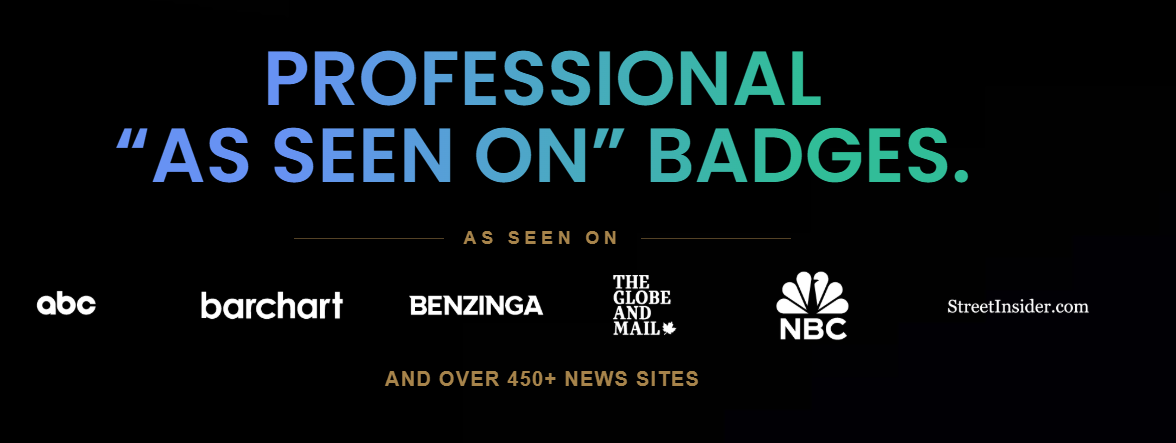
On LinkedIn, the Featured section exists specifically for this purpose. A press placement posted there — with the direct URL — stays permanently on your profile and appears whenever a prospect does their pre-call research. LinkedIn is the first place most B2B buyers look before a meeting. Media coverage in the Featured section answers the "who is this person, really?" question before it's asked.
In proposals, a one-line "As featured in X, Y, and Z" with hyperlinked publication names near your credentials section adds verifiable social proof at precisely the moment a client is evaluating whether your fee is justified. Buyers anchor pricing expectations to outcome value, not your labor. Press coverage raises the perceived outcome value of working with you.
The deployment move: Add your top placement to your email signature today. It takes four minutes and works on every email you send from this point forward.
This is the hack that compounds the most over time, and it requires no PR budget at all — only time and intellectual honesty.
AI retrieval systems, journalists, and buyers all share one preference: they cite and trust sources with original data. A claim backed by proprietary research — even a small survey, an internal benchmark, or an observed pattern from your client work — is categorically more credible than a claim assembled from commonly available information.
Google's May 2026 official AI search guidance explicitly defines non-commodity content as content "built on direct experience, original research, and unique expert perspectives that could not be produced by a generative AI model."
For a consultant, this translates to something practical. You have access to client situations, industry patterns, and operational data that no one else has. A survey of 25 professionals in your niche about a specific challenge they face.
A benchmark you've observed across client engagements — "in my experience working with mid-market logistics firms, the average gap between identified risk and remediation is 47 days." An observation about a pricing pattern, a hiring problem, or a technology adoption curve that your market hasn't quantified yet.
.png)
This original data point becomes the foundation of a piece of content — a LinkedIn article, a short blog post, a one-page research summary — that you own and can reference indefinitely. It's the kind of insight that journalists quote, that podcast hosts invite you to discuss, and that AI systems retrieve when someone asks a question in your domain.
The goal is not a comprehensive research study. It's one specific, attributable claim with a number or observable pattern attached to it that no one else can replicate because it comes from your direct experience.
The deployment move: Identify the one thing you've observed repeatedly across client engagements that your market treats as assumed but has never actually measured.
Write it down as a single sentence with a specific number or timeframe. That sentence is your original data point.
A podcast appearance is the most underused credibility asset in consulting — and one of the most efficient, because the host's audience trust transfers to you immediately and the recording lives permanently on the web.
The trust mechanism is different from press coverage.
Press features establish that a publication vetted you. Podcast appearances demonstrate your thinking in real time, which is closer to what a client experiences working with you. Research on founder behavior shows that podcast interviews "build trust faster than any blog post" because audiences experience the expert as a human voice with a specific point of view — not a polished marketing asset.
For placement strategy, the target is not the largest show in your category. It's the show with the most specific audience overlap with your ideal client. A 2,000-listener podcast whose audience consists entirely of the exact type of business owner you serve is more valuable than a 50,000-listener show in a tangentially related space. The metrics that matter are audience specificity and host credibility, not download numbers.
After the appearance, the recording becomes a permanent credibility asset you can share in proposals, link from your LinkedIn Featured section, and reference when prospects ask for proof of your expertise. Unlike a press release, a podcast episode shows rather than tells — which means it handles a different and equally important part of the buyer's credibility check.
Outreach to podcast hosts is simpler than most consultants assume. A two-paragraph pitch that identifies one specific insight you'd bring to their audience, connects it to a challenge their listeners face, and demonstrates you've actually listened to the show has a meaningful conversion rate. The constraint is specificity, not access.
The deployment move: Identify three shows your ideal client listens to. Listen to two episodes of each. Send one pitch per show this week with a specific, audience-relevant topic angle.
→ Related: How to use media mentions in your sales process
The distinction matters for how you justify this spend — to yourself, and to anyone whose approval you need.
A PR retainer is an ongoing operational expense with variable and often unverifiable returns. The five moves above are infrastructure investments: one-time or low-effort deployments that create permanent, reusable credibility assets. The press placement stays indexed. The badge works on every site visit. The email signature fires on every outreach. The original data point compounds every time it's cited. The podcast episode is findable for years.
The question is not whether you can afford to build credibility infrastructure. The question is what it costs you per month, per quarter, and per year to keep explaining who you are on sales calls when your competitors have already answered that question before the meeting starts.
Ready to get your first placement and put the badge on your site? Brand Featured's packages are built for exactly this — one-time, fixed-scope, with clear deliverables and no retainer. View the packages.


.png)
.png)
.png)