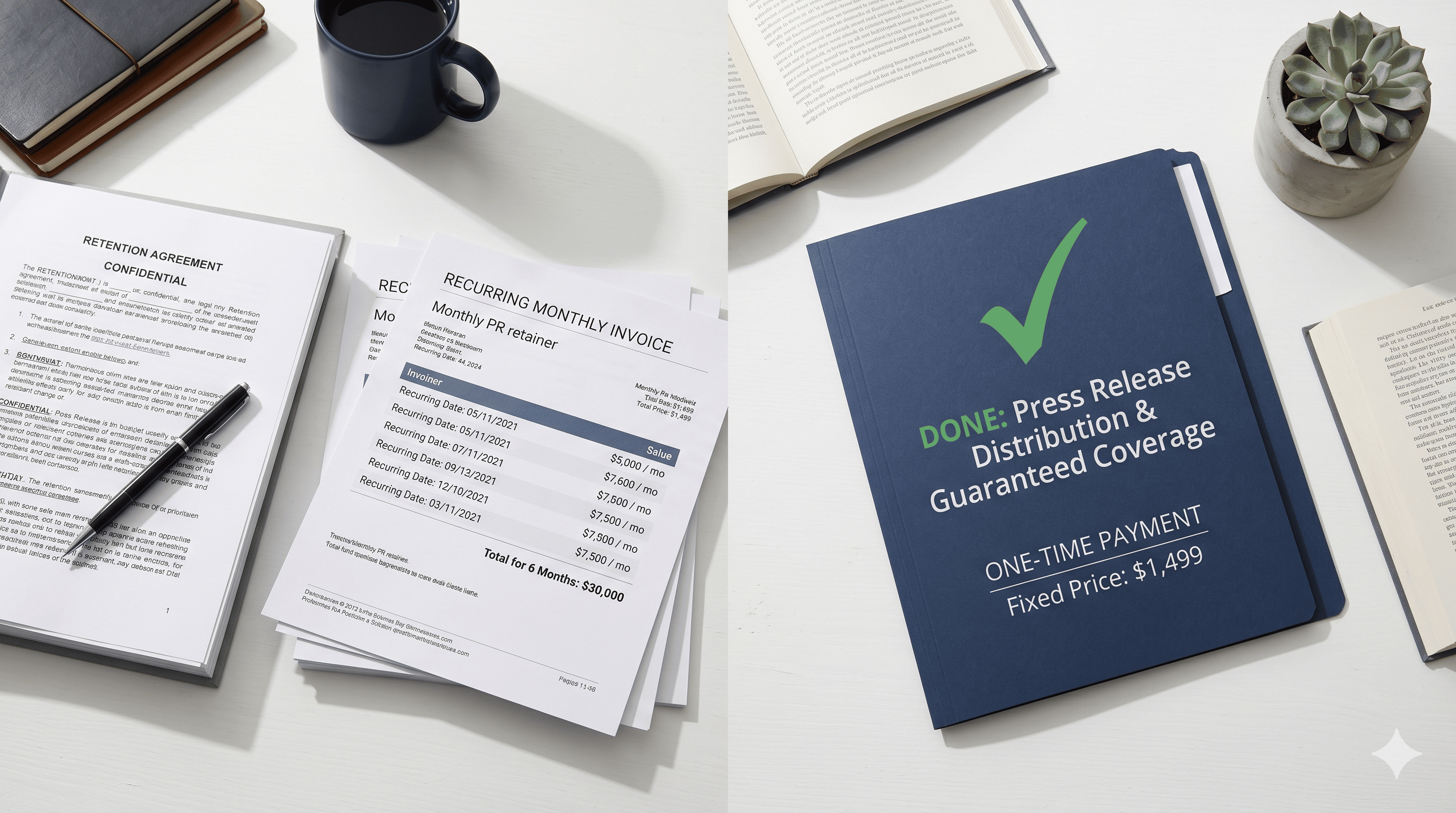
You have a product launch coming up. Or a funding round. Or you just watched a competitor get featured in a business publication and felt it. You know you need press coverage. The question sitting in front of you right now is whether to sign a monthly retainer or buy a one-time package.
This is not a small decision. A retainer that does not perform can cost you $5,000 to $10,000 per month with nothing verifiable to show for it. A package that does not match your stage wastes time and money you did not need to spend.
This post gives you a clear, honest comparison so you can make the right call before you spend anything.
Choosing between a PR retainer and a one-time package depends on your business stage, budget certainty, and how urgently you need results. Retainers suit large companies with ongoing news flow and internal PR oversight. One-time packages suit growing businesses that need credible media placements fast, with fixed costs and no long-term commitment.
What this comparison covers:
A PR retainer is a recurring monthly contract with an agency, typically ranging from $3,000 to $10,000 per month. You are paying for the agency's time, media relationships, and ongoing outreach activity. Not for placements. Not for results. For activity.
Most retainers bill for effort, not outcomes. Research from Authority Tech found that 68% of PR retainers lack clear placement metrics, meaning you pay a monthly fee with no contractual guarantee that a single piece of coverage will appear.
A SaaS founder who paid $5,200 per month for 13 months reported receiving 12 to 18 placements, most from lower-tier blogs with no measurable business impact. That is over $67,000 spent for coverage that moved nothing. The agency's internal defense was that "$5,000 is a tiny retainer." The founder's experience was a significant investment with zero return.
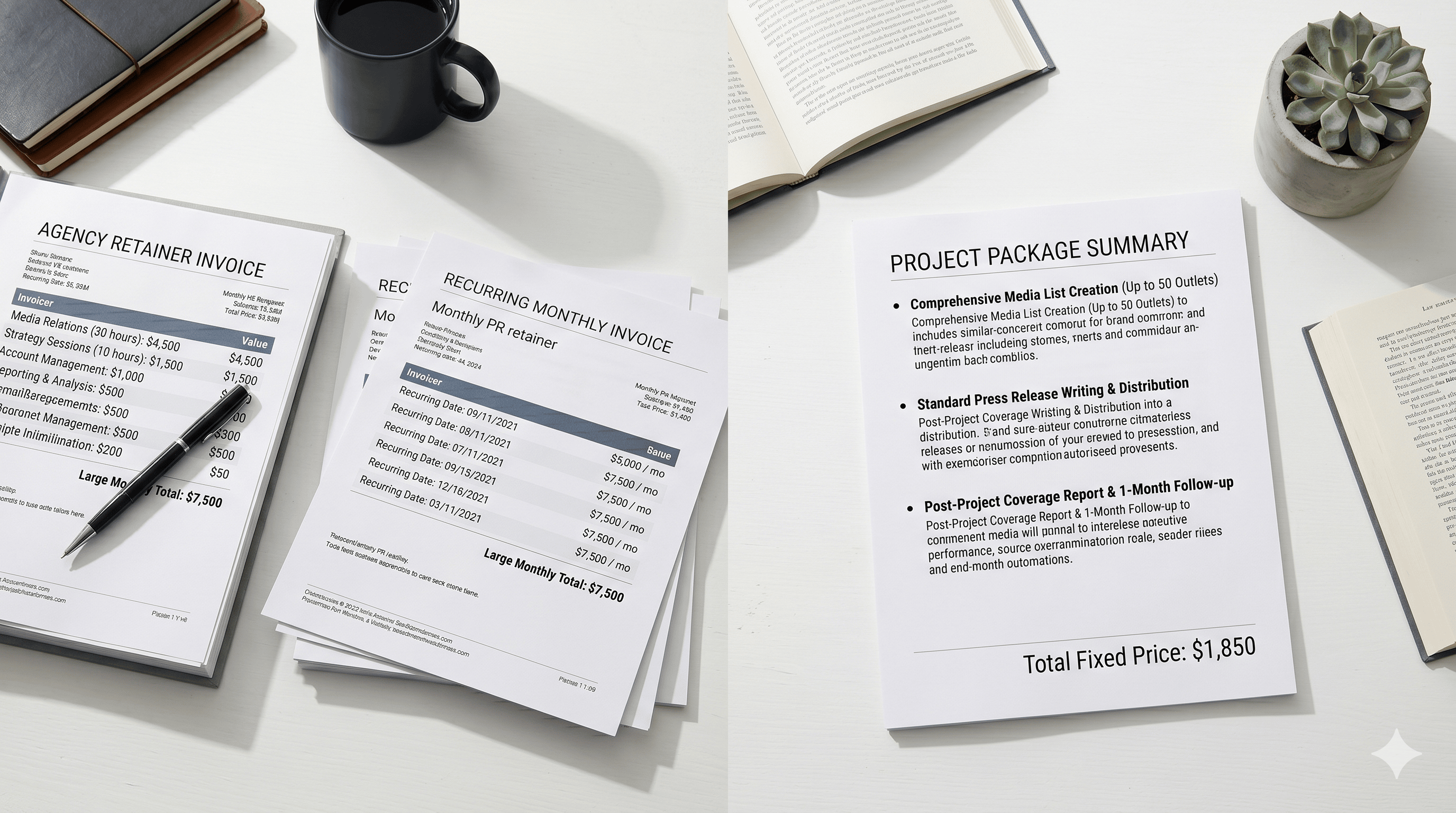
Pull out any retainer proposal you have received and count how many deliverables are defined by output rather than activity. If you see phrases like "ongoing media relations," "brand strategy development," or "consultation hours," those are activity-based commitments, not outcome-based ones.
You are paying for time, not results. That distinction matters enormously when you are three months in and coverage has not appeared.
If you want to understand why this model fails so many buyers structurally, the post on why traditional PR is failing covers the full breakdown.
A one-time PR package is a fixed-scope purchase. Fixed price, fixed deliverables, fixed media outlets, and a defined turnaround timeline. You buy it, it gets delivered, and you own the output permanently.
The productized model removes the three biggest sources of buyer regret in traditional PR: open-ended contracts, undefined deliverables, and unpredictable costs. A consultant preparing to pitch a new service, a startup announcing a product launch, or an ecommerce brand building credibility before a paid campaign all share the same core need.
They need verifiable media placements that show up in search, build authority, and create a record of legitimacy. They do not need 12 months of journalist relationship-building that may or may not produce coverage.
Ask yourself one honest question before deciding. Do you have a specific, time-sensitive reason to get media coverage in the next 30 to 60 days?
A launch, a fundraise, a sales conversation, a partnership discussion? If yes, a package is faster and more predictable than a retainer, which typically takes three to six months to produce meaningful coverage.
The output from a quality package does not disappear after the invoice clears. Each placement is indexed by Google, carries a direct link to an actual article about your company, and can be deployed as a verifiable credibility asset on your website. That is a permanent media record, not a logo wall. Explore the press release distribution packages to see exactly what each tier includes.
A retainer makes sense for a specific type of business. Not most businesses. A specific type.
You are generating consistent news: product updates, executive hires, funding rounds, regulatory filings, acquisitions. You have an internal marketing or communications team that can manage the agency relationship and hold them accountable week to week.
You have a budget of at least $5,000 per month that is pre-approved and does not require fresh justification each cycle. You have a timeline of at least six months before you expect measurable results.
If all four of those conditions are true, a well-vetted retainer agency can build meaningful journalist relationships over time and produce a volume of coverage that a one-time package is not designed to replicate.
Most SMBs, early-stage startups, and independent consultants do not meet all four conditions. That is not a judgment. It is a structural mismatch between what the retainer model requires and what most growing businesses actually have in place.
Score yourself honestly against those four conditions. If you hit fewer than three, a retainer is not the right entry point for your current stage. The post on whether PR agencies are worth it walks through the cost-benefit breakdown for each business size without the sales spin.
Getting a PR retainer approved internally is significantly harder than most marketers expect. It is also the reason more retainer conversations stall than people admit.
A retainer requires ongoing budget commitment. That means finance review, CFO sign-off in most organizations above a certain size, and often a legal review of contract terms. One marketing director described getting a $3,000 monthly retainer approved as a process that "took six weeks and three separate meetings." The package equivalent was approved in two days with a single email.
The reason is structural. A one-time purchase is treated as an operational expense. A retainer is treated as a recurring liability. Finance teams apply very different levels of scrutiny to each.
When you frame a media visibility purchase as a one-time investment with a fixed cost and verifiable output, you are speaking the language that gets approvals.
When you present a retainer, you are asking someone to commit to an open-ended recurring cost with no guaranteed deliverables. That is a harder internal sell, regardless of how credible the agency is.
If internal approval is part of your buying process, the post on PR for startups covers the budget framing language that actually works with boards and business partners.
The risk profile of a retainer and a one-time package are fundamentally different when results do not arrive on the expected timeline.
When a retainer underperforms, you are still under contract. A seasonal business owner documented paying $15,600 for a full-year contract that included ad spend she could not pause during her off-season. Another buyer cancelled after recognizing poor quality delivery but still had to pay an additional month under contract terms.
The agency's interest and your interest are not aligned in a retainer structure. The agency gets paid whether coverage appears or not. The contract protects their revenue, not your outcomes.
With a one-time package, the transaction is complete at delivery. If you are not satisfied, you are not locked into paying again next month.
The financial exposure is capped at the package price. That is a fundamentally different risk position than a retainer where dissatisfaction compounds monthly with no clean exit in sight.
Read the cancellation clause of any retainer proposal carefully before signing.
How many days' notice do you need to give? What happens to the current month's fee if you cancel mid-cycle? Is there a minimum contract period? Those answers define your actual risk exposure, not the headline monthly rate. And before committing to any PR provider, understanding the guaranteed media placement scam that operates across this industry will help you ask the right questions before you pay anything.
Here is the clearest way to make this call.
Choose a retainer if you have consistent news flow, an internal team to manage the agency, at least six months before expecting results, and pre-approved recurring budget above $5,000 per month.
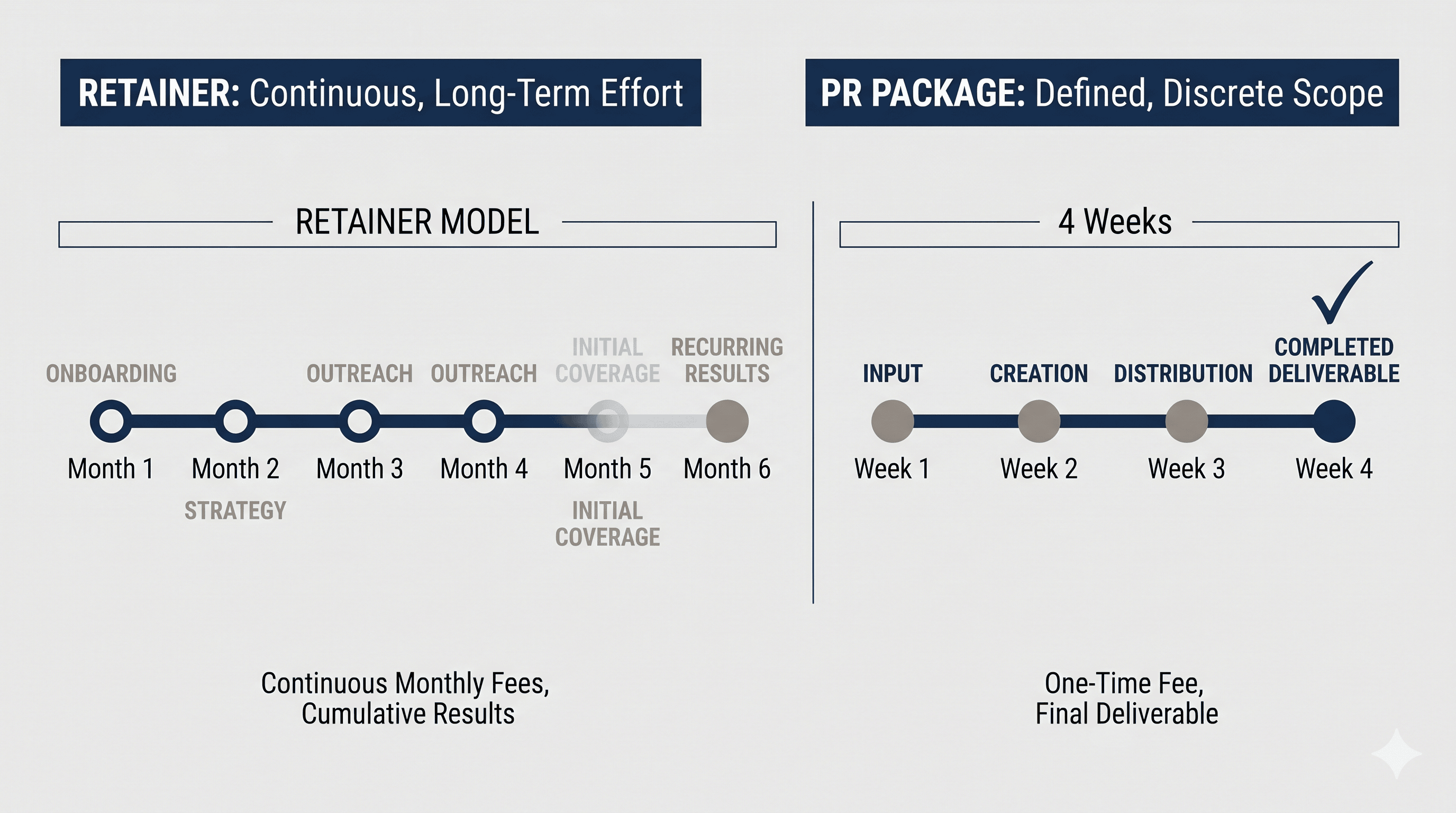
Choose a one-time package if you need results within 30 to 60 days, have a specific trigger event like a launch or funding round, need internal approval to be fast and low-friction, or want to test media visibility before committing to a larger investment.
Most businesses reading this post fall into the second category. Not because retainers are bad, but because the conditions that make retainers work are specific and relatively rare among growing businesses.
A one-time package gives you a verifiable output, a capped cost, and a credibility asset that lives in search results long after the purchase is complete. For most businesses at most stages, that is the smarter entry point.
A PR retainer is appropriate for your business when you have consistent news flow, an in-house marketing team to manage the agency relationship, a pre-approved recurring budget above $5,000 per month, and a realistic timeline of six or more months before expecting meaningful coverage. If any of those conditions are not met, a one-time PR package will almost always deliver better value for your current stage without locking you into ongoing costs that are difficult to justify or exit.
A one-time PR package typically includes a professionally written press release, distribution to a defined set of media outlets, indexed placements that appear in Google search results, and verifiable links to each article about your company. Quality packages also include assets you can deploy on your website, such as a dynamic media badge where each outlet logo links directly to your actual coverage. The scope, outlets, and turnaround time are fixed at the time of purchase with no ambiguity about what you are buying.
Most growing businesses benefit from one to three press release packages per year tied to specific trigger events such as a product launch, a funding announcement, a new market entry, or a leadership change. Spacing placements around real news moments produces more credible, indexed coverage than arbitrary scheduling. Regular placements also build a compounding media record that strengthens your authority in search results over time without requiring a monthly retainer commitment.
A traditional PR retainer typically costs between $3,000 and $10,000 per month with a minimum commitment of three to six months, meaning the minimum total investment ranges from $9,000 to $60,000 before you have a full picture of results. A productized one-time package typically costs between $500 and $3,000 for a defined set of placements with no recurring commitment. The risk-adjusted cost difference is significant, particularly for businesses that have not yet established which media channels drive measurable outcomes for their audience.
Yes, when press releases are distributed to outlets with genuine editorial environments and real domain authority, the resulting articles are indexed by Google and contribute to your company's searchable media presence. These placements generate backlinks from high-authority domains, which supports organic search rankings over time. The SEO impact depends on the authority level of the outlets where your release is placed, not on the volume of syndicated copies across low-quality wire service aggregators with no organic traffic.
A one-time PR package holds the provider accountable through the transaction itself. You pay for a defined deliverable and you receive it or you do not. A traditional PR retainer holds the agency accountable only through contract terms, which typically define activity rather than outcomes. Research shows that 68 percent of PR retainers lack clear placement metrics, meaning clients pay monthly fees with no contractual obligation for the agency to produce verifiable coverage. The accountability structures of these two models are fundamentally different and carry different risk profiles for the buyer.
MEDIA VISIBILITY PACKAGES FOR GROWING BUSINESSES
You have just worked through the real cost, risk, and fit of both options. If a one-time package matches your stage, here is the clearest next step.
Brand Featured has helped over 300 founders, SMBs, and consultants build verifiable media credibility without contracts, retainers, or vague deliverables.
Book a free 20-minute clarity call with Brand Featured. You will walk away with:
Not ready to talk? Browse the full package lineup and see exactly what each tier delivers before you make any decision.
Brand Featured is trusted by founders and growth-stage businesses across the U.S. and Canada who need credible press coverage without the retainer trap.


.png)
.png)
.png)