If you've published solid content, optimized your pages, and still watch competitors with thinner material outrank you — E-E-A-T is likely the gap nobody told you about.
Google's quality evaluation framework, E-E-A-T, assesses whether your website demonstrates real Experience, genuine Expertise, recognized Authoritativeness, and verifiable Trustworthiness. It doesn't just weigh your words. It weighs the signals outside your site that confirm you are who you claim to be.
This matters for a specific reason: in 2025, Google expanded AI Overviews to appear on roughly 48% of all searches, up from 6.5% the year before. The systems generating those overviews don't start from scratch — they select from sources they already recognize as credible. If your E-E-A-T signals are thin, you are invisible to them.
Media coverage on real, high-authority publications is one of the fastest verifiable ways to build E-E-A-T across all four signals simultaneously — and the results show up in search rankings, brand authority signals, and AI citation rates. This post explains exactly how.
E-E-A-T is Google's framework for evaluating whether a website is credible enough to rank and be cited by AI search systems. It stands for Experience, Expertise, Authoritativeness, and Trustworthiness. Media coverage on recognized publications directly builds all four signals — placing your brand on third-party sources Google already trusts, creating verifiable proof that no amount of on-page optimization alone can replicate.
E-E-A-T stands for Experience, Expertise, Authoritativeness, and Trustworthiness. Google introduced the framework through its Search Quality Rater Guidelines and added the first "E" — Experience — in December 2022, recognizing that first-hand knowledge of a topic carries different weight than academic or secondhand expertise.
The four signals work together, not in isolation. A financial consultant with twenty years of client work demonstrates Experience. The certifications and track record they hold demonstrate Expertise. The publications and associations that reference them demonstrate Authoritativeness. The absence of complaints, retracted claims, or unresolved disputes demonstrates Trustworthiness.
Trustworthiness is the load-bearing signal. Google's own guidelines describe it as "the most important member of the E-E-A-T family." A site can have genuine expertise and still rank poorly if it lacks verifiable trust signals: no third-party mentions, no external validation, no indication that anyone outside the organization considers it credible. This is precisely where media coverage does work that no other tactic can easily replicate.
When a recognized publication publishes coverage about your business, four things happen simultaneously from an E-E-A-T perspective — each one building a signal that Google can independently verify.
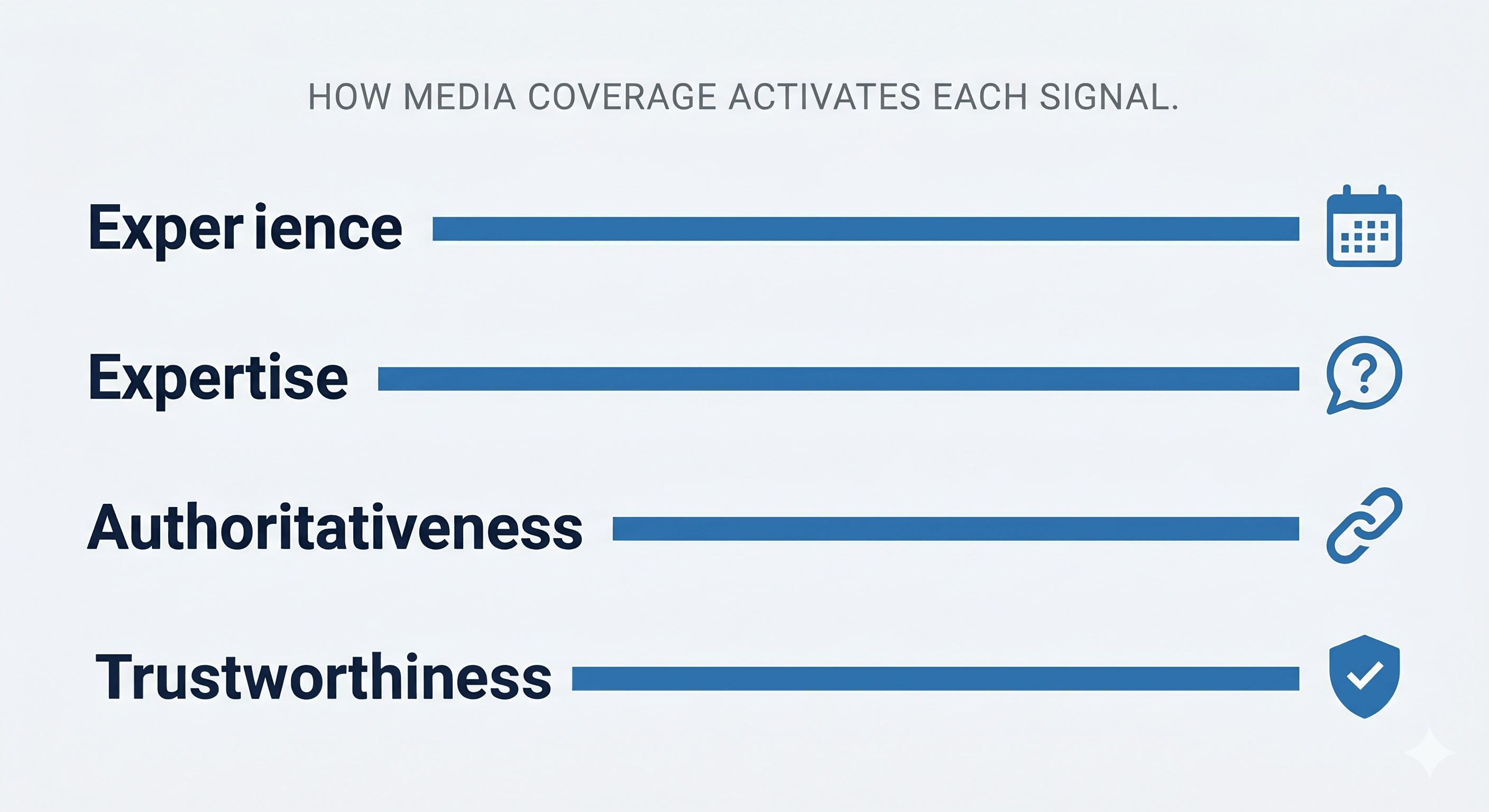
Google defines Experience as verifiable evidence that an entity has direct, first-hand involvement with the topic at hand. For businesses, this means something more than a well-written About page. A press release announcing a product launch, a client milestone, or an industry observation creates a timestamped, indexed record that your company has been active and newsworthy in the real world. The coverage exists on a domain Google already evaluates. Your activity is no longer self-reported.
Expertise signals are strongest when confirmed externally rather than claimed internally. When a publication summarizes your perspective, attributes a quote to your founder, or positions your business as a resource in a given field, it performs a form of editorial vetting. The publication's credibility becomes partially associated with yours.
Nielsen research consistently validates why this matters: earned media generates 92% more credibility with consumers than paid advertising. Audiences understand, even without articulating it, that editorial coverage involves a judgment call from someone with standards. That perceived judgment is an expertise signal that self-published content cannot produce on its own.
Authoritativeness is the E-E-A-T signal most directly tied to off-site behavior. Google evaluates it by looking at what other recognized entities say, link to, or mention about your brand. This is why backlinks from high-domain-authority publications carry disproportionate weight in any authority-building strategy.
A press release distributed to recognized news outlets generates indexed mentions of your brand on domains with established authority profiles. Buyers and SEO practitioners consistently identify press links as the highest-value backlink category — because they come from editorially controlled environments that cannot be gamed or purchased outright.
Clients receiving strategic PR services have been documented earning 50 to 70 referring domains with domain ratings between 60 and 95 over a twelve-month period. Understanding how media mentions elevate brand authority makes it clear why this kind of authority profile is difficult to replicate through other link-building approaches at comparable speed or cost.
Trustworthiness is the hardest signal to manufacture and the easiest to verify independently. Google's systems and human quality raters look for consistent, verifiable evidence that a business exists as described and has been recognized by others who are not the business itself.
Media coverage creates exactly this kind of proof. One bootstrapped founder documented this effect directly: after displaying media logos linked to actual indexed coverage — the kind of verifiable "As Seen On" proof that Brand Featured's dynamic media badge delivers — they reported a 30% increase in visitor engagement and unsolicited investor interest. The coverage was the trust signal. The logos linked to real articles were the receipts.
E-E-A-T is not a traditional ranking factor in the sense of a measurable score. Google does not publish an E-E-A-T metric. What it does is use E-E-A-T as a quality threshold — a filter through which content must pass before being selected for top positions, AI Overview citations, or generative search responses.
.png)
As of May 2026, Google AI Overviews appear on roughly 48% of all searches. AI Mode has crossed 100 million monthly active users. For nearly half of all queries, the first result a user sees is an AI-generated response assembled from sources the system has already determined to be credible. If your site doesn't clear the E-E-A-T threshold, it is not considered — regardless of content quality.
ChatGPT, Perplexity, and Gemini operate on similar selection logic. Analysis of AI citation patterns found that earned media domains account for roughly 32% of all domains that AI models cite, with that share reaching as high as 87% in certain topic categories. If you're asking why your brand isn't showing up in AI-generated answers, the E-E-A-T credibility gap is a primary cause — and it's the same gap that Brand Featured's SEO and AI optimization approach is built to close.
The compound effect: coverage ranks, coverage generates backlinks, coverage becomes a signal that AI systems use to recognize your brand as a known entity. Known entities get cited. Unknown ones don't.
The most common mistake is treating E-E-A-T as an on-page problem. Founders and marketers add author bios, cite sources, and improve content depth — all useful — and then wonder why rankings barely move. On-page signals matter, but they operate within a context Google has already formed about your site based on external evidence.
Google's quality rater guidelines are explicit: a site can produce high-quality content and still receive a low overall quality rating if there is no external evidence of its reputation. The full picture of how website authority is built and measured makes clear that external validation — not just on-site optimization — is the differentiating variable.
The second mistake is confusing owned activity with verifiable proof. Social posts, blog content, and email newsletters build audience — but they don't build the kind of externally verifiable credibility that E-E-A-T requires. Google draws a clear distinction between what you say about yourself and what independent, editorially controlled sources say about you. Only the latter counts as a trust signal.
The third mistake is distributing press releases to low-authority aggregator sites and expecting meaningful SEO benefit. Traditional PR agencies versus modern media visibility services reveals exactly why distribution outlet quality determines whether a press release builds genuine E-E-A-T or wastes the investment entirely. The outlet matters as much as the content.
Coverage that isn't deployed is coverage that doesn't work. Most businesses treat press features as announcement moments — one social post, one email, then nothing. The E-E-A-T value of that coverage sits unused because the signal never connects to the place where buying decisions happen: your website.
Three steps turn a press placement into a live E-E-A-T asset.
First, every piece of coverage should be linked on your website in a way that Google can crawl and visitors can verify. This means linking the publication logo or mention directly to the indexed URL of the actual coverage — not to the publication's homepage.
A logo with no destination is a design element. A logo linked to live, indexed coverage is a trust signal. Brand Featured's dynamic media badge does this automatically: each logo links directly to the client's real press coverage, making every placement a verifiable proof point rather than a decorative claim.
Second, internal linking from your blog and landing pages to your media mentions reinforces your topical authority cluster. When your content on a given subject links to external coverage about that same subject on a high-authority domain, you are building a verifiable authority network rather than a self-referential one.
Third, treat each piece of coverage as a permanent digital asset. Unlike paid advertising that stops performing the moment spending stops, an indexed press placement continues carrying authority signals for as long as the article remains live. The compounding value of media coverage is that it builds over time without additional investment.
Yes — provided it is distributed to and indexed on real, recognized publications with genuine editorial standards. What matters is where the content lands, not the format in which it started. A press release published on a media outlet with established domain authority creates the same indexed mention as any other form of coverage. Our FAQ covers the specific outlet categories Brand Featured distributes to and what distinguishes credible distribution from aggregator syndication.
The indexing and backlink credit from a high-authority media placement typically registers within days to a few weeks. The downstream E-E-A-T effect — built from multiple mentions on recognized domains — develops over months as coverage compounds. Research tracking PR-driven authority signals has found that high-domain-authority placements can push negative search results to page two within 30 to 60 days, indicating that the authority transfer from coverage to brand is measurable and comparatively fast relative to other organic channels.
It matters significantly. Google evaluates authoritativeness by looking at the recognized standing of the publications that mention you. A link from a publication with genuine editorial standards and a high domain rating carries substantially more authority signal than ten links from content mills. This is why PR strategy and SEO are inseparable: the quality of the outlet determines whether the coverage becomes a genuine E-E-A-T signal or noise.
Most businesses have a credibility gap they cannot close with content alone. They produce good material, build reasonable websites, and still find that search engines and AI systems underweight them relative to competitors who have accumulated external recognition over time.
E-E-A-T is Google's way of formalizing what people already understood intuitively: what others say about you is more credible than what you say about yourself. Media coverage on recognized publications is one of the few investments that directly addresses this gap — creating verifiable, indexed, permanently accessible proof of your brand's legitimacy that Google can evaluate, visitors can click, and AI systems can cite.
The coverage doesn't just help you rank. It helps visitors trust you. It helps AI systems recognize you. And it keeps doing both long after you've moved on to the next priority.
Brand Featured delivers professionally written press releases distributed to recognized, high-authority media outlets — with transparent pricing, clear deliverables, and no retainer.
View media visibility packages and choose your entry point.


.png)
.png)
.png)